If you publish a novel and someone copies it, proving theft is easy: the characters, dialogue, and plot belong to you. But what if you publish a dictionary, an encyclopedia, or a city map?
You can’t copyright the definition of “apple,” the birth-date of Abraham Lincoln, or the location of Main Street. Facts belong to the public domain. For decades, reference publishers faced a massive problem: how do you stop a competitor from simply buying your heavily researched book, copying all the public-domain facts, and selling it as their own work?
To protect their intellectual property, publishers had to get sneaky. They started hiding deliberate lies among the truth. Welcome to the world of copyright traps.
The Mountweazel: An Encyclopedia’s Ghost
The most famous type of literary copyright trap is the Mountweazel. The term originates from the 1975 edition of the New Columbia Encyclopedia.
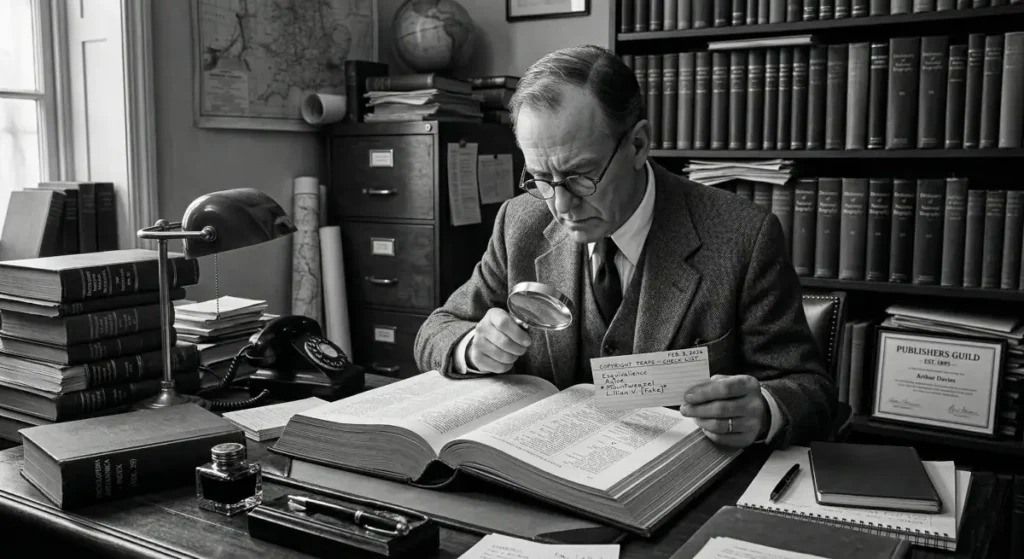
To protect their exhaustive biographical data, the editors completely fabricated the life of a woman named Lillian Virginia Mountweazel. According to her entry, she was an American fountain designer and photographer, celebrated for her photo essay of rural mailboxes, who tragically died in an explosion in 1973.
None of it was true. But if a rival publisher released a new encyclopedia that also included the tragic tale of Lillian Mountweazel, Columbia University Press would have undeniable proof of plagiarism in a court of law. Independent research would never yield a biography of a person who didn’t exist.
The Nihilartikel: Dictionaries and Fake Words
When this tactic is used in dictionaries, it is often referred to by the wonderful German word Nihilartikel (literally: “nothing article”).
Lexicographers will occasionally invent a completely fake word, give it a plausible pronunciation guide, and write a standard definition. One of the most famous modern examples occurred in the 2001 New Oxford American Dictionary.
Esquivalience (noun): The willful avoidance of one’s official responsibilities.
The word was entirely made up by editor Christine Lindberg. Sure enough, shortly after publication, “esquivalience” began miraculously appearing in rival dictionaries and online portals, proving that competitors were scraping Oxford’s data rather than doing their own lexicography.
Trap Streets: The Cartographer’s Secret Weapon
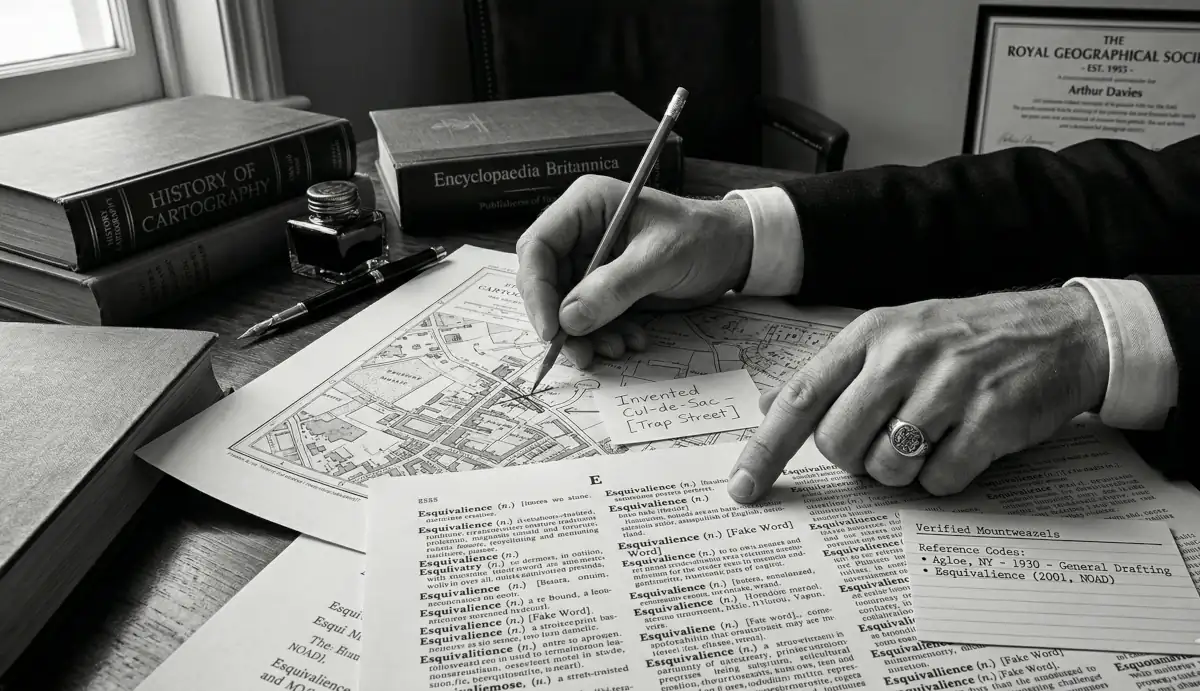
Mapmakers have perhaps the hardest job of all when it comes to copyright. To protect their painstakingly surveyed street maps, cartographers employ what are known as trap streets.
A trap street is a minor, fictitious road inserted into a map. It might be a tiny cul-de-sac drawn where a solid block of houses actually sits, or a fake name applied to an otherwise unnamed dirt road.
The most legendary trap street in history actually backfired in the most spectacular way possible: Agloe, New York.
- In the 1930s, the General Drafting Company created a fake town called Agloe on a dirt road map of New York State as a copyright trap.
- Years later, the rival company Rand McNally published a map that included Agloe.
- General Drafting sued for copyright infringement.
- However, Rand McNally won the case. Why? Because somebody had seen the original map, driven to the empty intersection, and built the “Agloe General Store.” Because the store physically existed, Rand McNally successfully argued that Agloe was now a real place, making the fact public domain!
Why Copyright Traps Still Matter Today
In the era of AI and digital data scraping, the concept of the Mountweazel is more relevant than ever. Tech companies, database managers, and online directories still use “dummy data” to track whether their information is being illegally scraped by automated bots. If a piece of software ingests a database and spits out a uniquely identifiable, fake data point, the original creators know exactly who stole their work.
Summary Table: Types of Copyright Traps
| Trap Name | Medium | Famous Example | Result / Purpose |
| Mountweazel | Encyclopedias / Biographies | Lillian Virginia Mountweazel | Proves unauthorized copying of biographical data. |
| Nihilartikel | Dictionaries / Glossaries | Esquivalience | Catches rival lexicographers stealing definitions. |
| Trap Street | Maps / Cartography | Agloe, New York | Protects expensive geographic surveys from replication. |
The next time you are flipping through a heavy reference book or looking at a highly detailed map, remember that you might be looking at a carefully constructed illusion. In order to protect the absolute truth, sometimes you have to publish a little bit of fiction.