
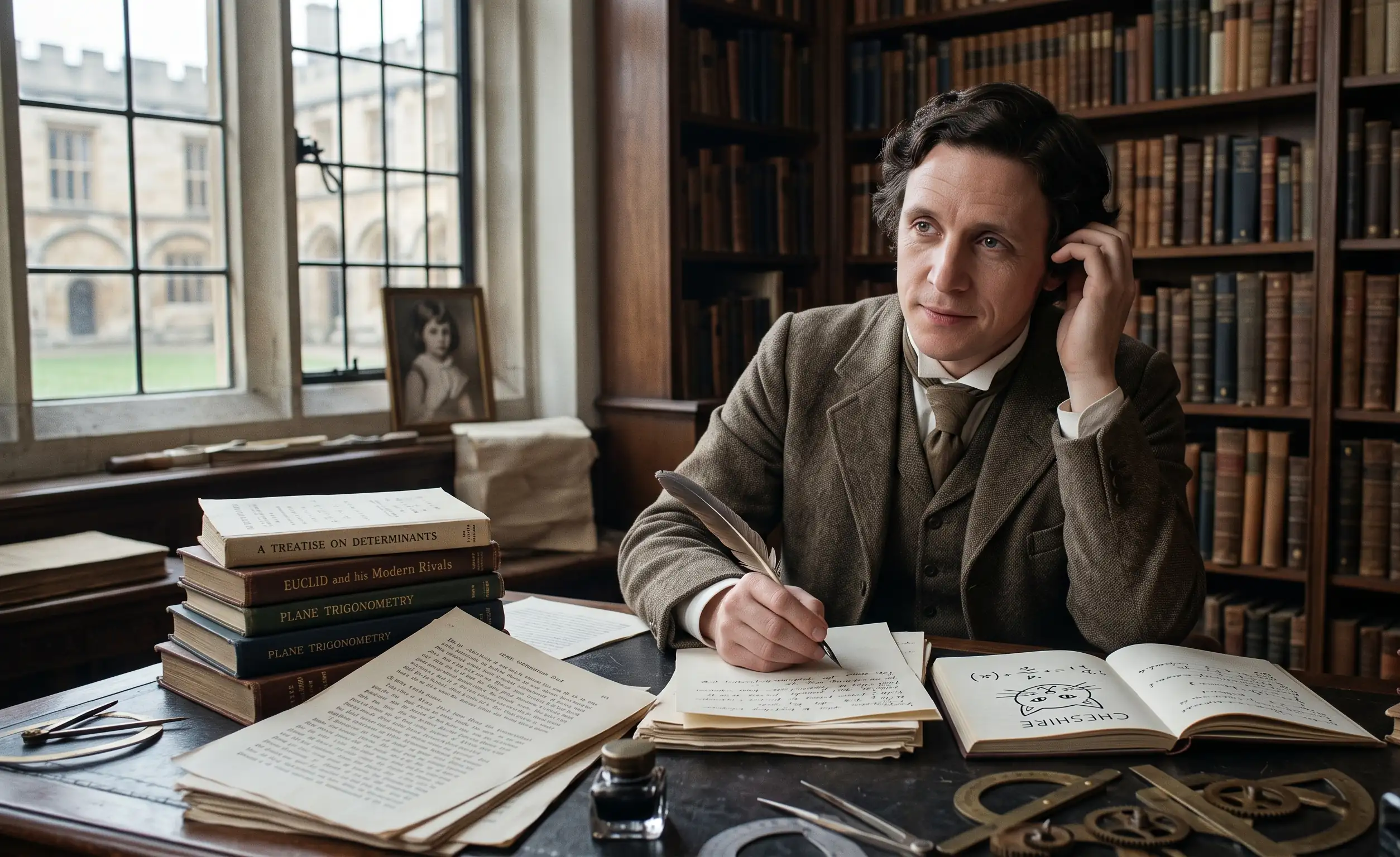
For more than a century, pop culture has insisted on treating Alice’s Adventures in Wonderland as the ultimate Victorian drug trip. Readers love to imagine Charles Lutwidge Dodgson—writing under the pen name Lewis Carroll—dreaming up smoking caterpillars, grinning felines, and psychotropic mushrooms in a cloud of hallucinogenic whimsy.
The truth is much stranger, far pettier, and infinitely more mind-boggling: Alice in Wonderland is a vicious, book-length satire aimed at cutting-edge nineteenth-century mathematics.
Behind the pseudonym, Dodgson was an ultra-conservative mathematics don at Christ Church, Oxford. He revered Euclid. He believed mathematics had one sacred job: to describe physical, observable reality through rigorous geometric proof. But the mid-1800s were tearing that worldview to shreds. Modern thinkers were introducing baffling abstractions—imaginary numbers, projective geometry, and multi-dimensional algebra. Dodgson was utterly horrified. To him, divorcing math from physical reality was unhinged nonsense. So, rather than simply publish dry academic counterarguments that few would read, he weaponized children’s literature to write a passive-aggressive academic hit piece.
The Cat That Solved Nothing
Consider the Cheshire Cat. Its body vanishes gradually, starting with the tip of the tail and ending with the grin, which remains behind suspended in mid-air. Alice remarks that she has often seen a cat without a grin, but never a grin without a cat.
This is not absurd poetry; it is a direct parody of symbolic algebra.
In traditional mathematics, symbols stood for concrete quantities—three apples, a five-foot rope, a measured angle. But British mathematicians like George Peacock and Augustus De Morgan began proposing that algebra could operate on purely abstract symbols divorced from real-world referents. You could manipulate variables according to formal rules even if the variables themselves represented impossible or non-existent physical objects.
To Dodgson, a mathematical property existing without a physical object was as insulting and logically fraudulent as a facial expression hanging in a tree without a skull to anchor it.
The Quaternions at the Tea Table
The mathematical mockery reaches its absolute zenith at the Mad Tea Party.
In 1843, Irish mathematician William Rowan Hamilton had a breakthrough while walking along Brougham Bridge in Dublin: quaternions. Standard complex numbers operate in two dimensions, but Hamilton realized that to calculate rotations in three-dimensional space, he needed a four-term number system involving three spatial dimensions ($i, j, k$) and a fourth dimension representing time.
If time is present, the quaternion equations work in continuous motion. If time is removed, the system collapses, and the three spatial variables can do nothing but cycle endlessly in place.
Look at the tea table. There are three characters seated: the Mad Hatter, the March Hare, and the Dormouse. They represent the three spatial dimensions. What is missing? Time.
The Hatter explicitly tells Alice that he quarrelled with Time the previous March. Because Time refused to cooperate, it is always six o’clock. Without the fourth variable to drive the system forward, the three companions are doomed to rotate endlessly around the table, shifting one seat over, drinking tea from dirty cups, and repeating the cycle forever. Dodgson was telling Hamilton that his four-dimensional math was a stagnant parlor trick that trapped its own variables in purgatory.
The Unstable Body
Alice’s bodily dysmorphia throughout the book directly targets projective geometry, pioneered by French mathematicians Jean-Victor Poncelet and Arthur Cayley. Projective geometry studied the properties of figures that remain invariant under projection—the way shapes stretch, shear, and warp when cast as shadows or viewed from severe angles without technically changing their fundamental relations.
When Alice eats the Caterpillar’s mushroom, her neck elongates so drastically that her head towers above the tree canopy, leading a terrified pigeon to mistake her for a serpent. Alice insists she is a little girl, but the pigeon’s geometric logic holds: she has an undulating neck and she eats eggs, so by structural definition, she is a serpent.
Dodgson was satirizing the idea that an object could undergo grotesque, reality-bending spatial transformations while theorists stubbornly insisted it remained “the same” mathematical entity.
The most mind-bending realization of English classic literature is that generations of readers have fallen asleep to the bedtime story of a girl tumbling down a rabbit hole, entirely unaware they are reciting the calculated grievances of an Oxford don having a generational meltdown over abstract algebra. Wonderland is not an escape from logic; it is what happens when logic is pushed so far into the abstract that it forgets how to exist in the real world.