

Have you ever looked at the back of a book and noticed the barcode? Above those black lines sits a 13-digit number known as the ISBN (International Standard Book Number). But if you look closely at the prefix of almost any modern book, you’ll see the numbers 978 or 979.
In the world of global trade, these prefixes usually identify a specific country—France is 300-379, the UK is 50, and the US is 00-13. So, where is “978” located?
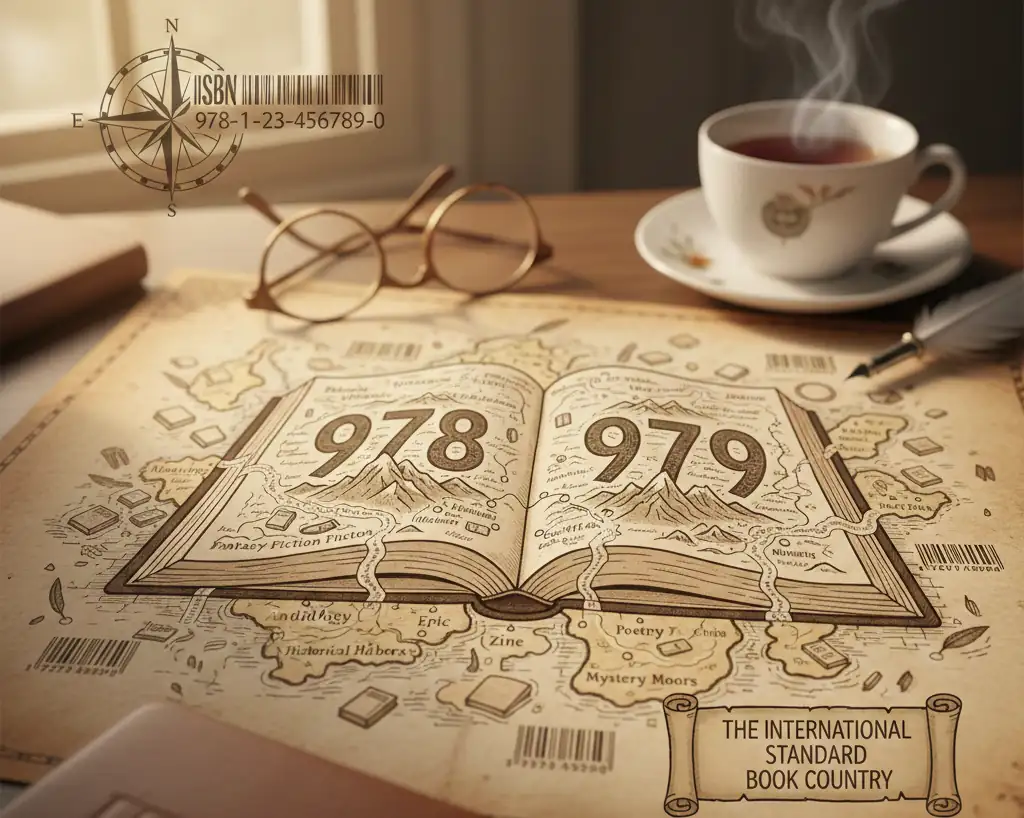
Welcome to Bookland: the most populous, diverse, and entirely fictitious country on Earth. Here is the fascinating story of why publishers had to invent a nation to keep the literary world from collapsing under its own weight.
The Crisis: When 10 Digits Weren’t Enough
For decades, the publishing industry relied on a 10-digit ISBN system. Established in 1970, the ISBN-10 was a mathematical marvel of its time. It used a specific formula to ensure every book had a unique identifier, categorized by language, publisher, and title.
However, by the late 1990s, the industry hit a wall. Two major factors triggered an existential crisis for book identification:
- The Digital Explosion: The rise of self-publishing and e-books meant that the volume of new titles was skyrocketing.
- Global Supply Chains: Retailers were moving toward the EAN-13 (European Article Number) barcode system used for every other consumer product, from cereal boxes to shampoos.
The 10-digit system was running out of combinations, and it didn’t play nice with the scanners used in modern warehouses. The industry needed more digits, but more importantly, it needed a way to fit books into the global retail ecosystem without losing their unique identity.
The Birth of Bookland
To integrate books into the EAN-13 barcode system, every product needs a “country code.” Since books are a global commodity often published in one country and sold in another, assigning them to a single physical nation (like the US or Germany) created a logistical nightmare for international distribution.
The solution was as creative as the stories found within the books themselves. The International ISBN Agency and the EAN (now GS1) decided to designate a fictitious country specifically for books.
They carved out the prefix 978 (and later 979) and christened it Bookland.
Definition: Bookland is a “country” that exists only for the purpose of the EAN database. It allows books to be treated as their own geographic entity, regardless of where they are printed or sold.
By “registering” every book in Bookland, the industry achieved two things:
- Compatibility: Books could now be scanned by any standard retail barcode reader.
- Expansion: It effectively doubled (and eventually tripled) the number of available ISBNs.
How the Transition Worked (ISBN-10 to ISBN-13)
The shift wasn’t just about adding three numbers to the front. It required a global overhaul of database systems. On January 1, 2007, the industry officially moved to the 13-digit standard.
The transition relied on a clever bit of math. To convert an old 10-digit number to a 13-digit one:
The 978 prefix was attached to the front.
The original 10-digit ISBN was stripped of its final “check digit.”
A new check digit was calculated using the EAN-13 algorithm to ensure the number was valid.
Why Bookland Matters for SEO and Modern Publishing
If you are a self-published author or a small press, understanding the “Bookland” EAN-13 structure is vital for your metadata strategy. Search engines and retail algorithms (like Amazon’s A9) rely heavily on these identifiers to categorize your work.
Global Discoverability: Because your book belongs to “Bookland,” it is indexed in a way that makes it universally recognizable across international borders.
Inventory Accuracy: Using a 13-digit ISBN prevents “ghost listings” where a 10-digit version and 13-digit version of the same book are treated as different products.
The Future: Expanding the Borders of Bookland
As of today, the 978 “territory” of Bookland is nearly full. This is why you will increasingly see books starting with 979. While 978 was almost an exact mirror of the old 10-digit system, 979 allows for an entirely new range of numbers, ensuring we won’t run out of room for new stories for several decades.
It’s a rare instance where the “dry” world of international logistics and the “imaginative” world of literature met in the middle. To save the physical book, we had to invent a digital country.
Summary Table: ISBN-10 vs. ISBN-13
| Feature | ISBN-10 | ISBN-13(Bookland) |
| Standard Prefix | None | 978 or 979 |
| Digits | 10 | 13 |
| Barcode Format | Often custom | Universal EAN-13 |
| Official Start | 1970 | 2007 |
| Capacity | ~1 Billion Titles | ~Trillions |
The next time you pick up a paperback, take a second to look at that barcode. You aren’t just holding a story; you’re holding a passport to a country that doesn’t exist, but keeps the entire world of reading organized.